
Apple is the most secretive acquirer in tech. While Google and Meta announce acquisitions with press releases and price tags, Apple quietly absorbs companies - often without any public acknowledgment at all. We've tracked over 120 Apple acquisitions, but the real number is likely much higher.
Apple's strategy is fundamentally different from other tech giants: rather than buying companies for their products or users, Apple acquires technology and talent that disappears into future Apple products. You've probably used Apple features that came from acquisitions you never heard of.
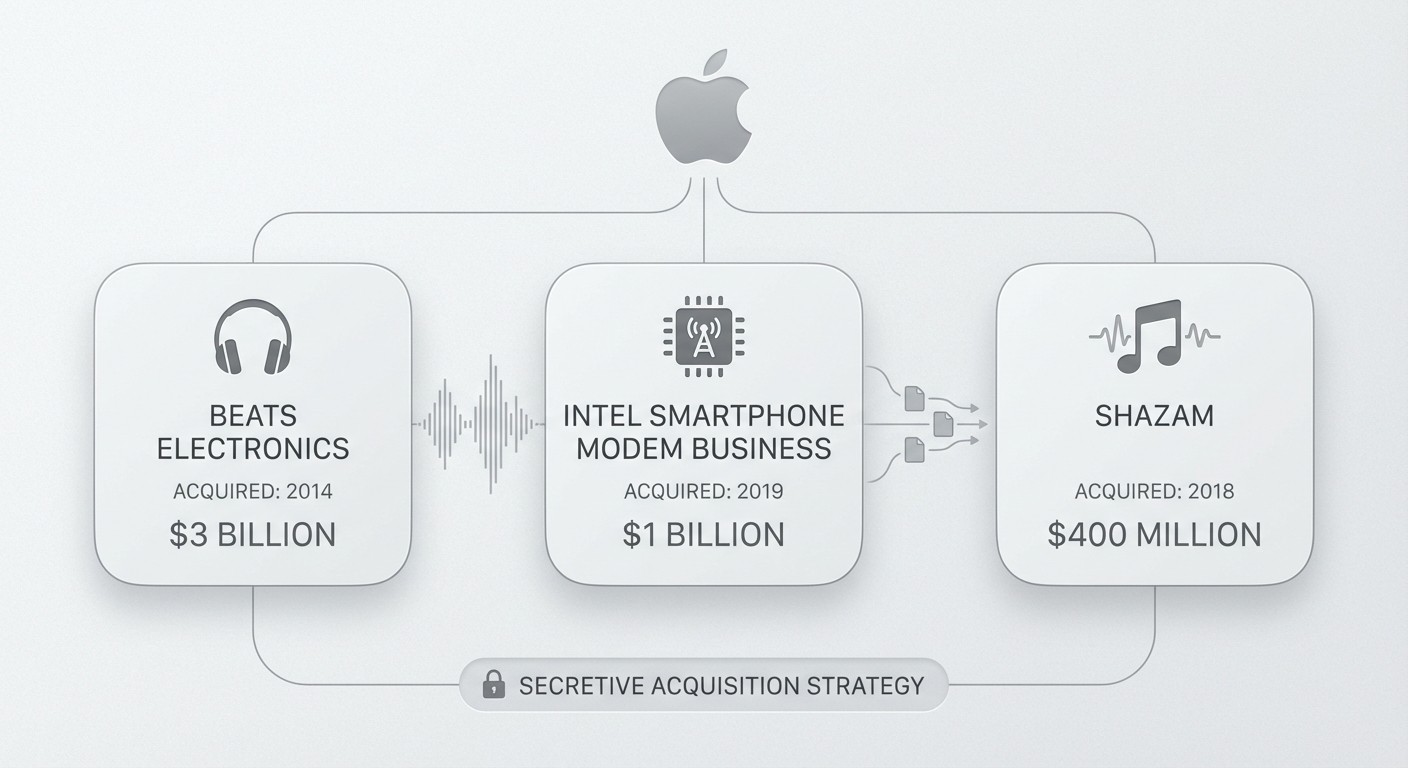
Key Statistics
- Total Known Acquisitions: 120+ companies
- Largest Deal: Beats Electronics - $3 billion (2014)
- Average Acquisitions/Year: 15-20 (mostly unannounced)
- Most Common Type: Technology absorption (no product continues)
- Disclosure Rate: ~30% of deals publicly confirmed
Apple's Biggest Acquisitions
| Company | Year | Price | What It Became |
|---|---|---|---|
| Beats Electronics | 2014 | $3B | Apple Music, AirPods foundation |
| Intel Modem Business | 2019 | $1B | Custom iPhone modems (in development) |
| Shazam | 2018 | $400M | iOS music recognition, Siri integration |
| Dialog Semiconductor (part) | 2018 | $600M | Power management chips |
| Texture (Next Issue) | 2018 | Undisclosed | Apple News+ |
| Dark Sky | 2020 | Undisclosed | Apple Weather app redesign |
| PA Semi | 2008 | $278M | Foundation of Apple Silicon (M1, M2) |
| Intrinsity | 2010 | $121M | A4 chip and successors |
| AuthenTec | 2012 | $356M | Touch ID fingerprint sensor |
| PrimeSense | 2013 | $360M | Face ID depth sensing |
The Apple Acquisition Playbook
Apple's approach to M&A is distinctive:
1. Stealth Mode
Apple rarely announces acquisitions. When asked, the standard response is: "Apple buys smaller technology companies from time to time, and we generally do not discuss our purpose or plans." This boilerplate has accompanied dozens of deals.
2. Technology Absorption
Unlike Google or Meta, Apple almost never keeps acquired products running. The technology disappears into Apple's ecosystem. Shazam is a rare exception - it still exists as a standalone app.
3. Talent Retention
Apple is known for keeping acquired teams together and giving them significant autonomy within Apple. The PA Semi team that built Apple Silicon stayed together for over a decade.
4. Strategic Timing
Apple often acquires companies 2-3 years before the technology appears in products. The PrimeSense acquisition (2013) powered Face ID (2017).
Acquisitions That Shaped Apple Products
Apple Silicon: PA Semi + Intrinsity + More
Apple's M1/M2/M3 chips - which revolutionized Mac performance - trace back to the 2008 PA Semi acquisition. Apple spent over a decade and acquired multiple chip companies before unveiling Apple Silicon in 2020.
Touch ID: AuthenTec
The AuthenTec acquisition in 2012 gave Apple the fingerprint sensor technology that became Touch ID in the iPhone 5s (2013). Apple paid $356 million and integrated the team into its hardware division.
Face ID: PrimeSense
PrimeSense created the depth-sensing technology used in Microsoft Kinect. Apple acquired them in 2013, and four years later, Face ID debuted in the iPhone X.
Siri: Three Acquisitions
Siri itself was acquired in 2010, but Apple continued acquiring AI companies to improve it: Vocal IQ (2015), Turi (2016), and numerous others have been folded into Siri development.
The Beats Deal: Apple's Largest Acquisition
In 2014, Apple paid $3 billion for Beats Electronics - by far its largest acquisition. The deal was unusual for Apple:
- It included a consumer brand (Beats headphones)
- It included a streaming service (Beats Music)
- It brought celebrity executives (Dr. Dre, Jimmy Iovine)
Beats Music became Apple Music in 2015. The Beats brand continues as Apple's "lifestyle" headphone line, while AirPods (which share technology lineage) became Apple's own premium product.
Failed and Blocked Acquisitions
Acquisitions Apple Didn't Make
Apple reportedly considered but didn't pursue:
- Tesla - Talks in 2013, Musk wanted to be CEO
- Disney - Steve Jobs (Disney's largest shareholder) discussed before his death
- Netflix - Reportedly approached multiple times
- Time Warner - Explored before AT&T acquisition
Recent Apple Acquisitions (2020-2024)
| Company | Year | Focus |
|---|---|---|
| Dark Sky | 2020 | Weather app |
| Voysis | 2020 | AI voice technology |
| Vilynx | 2020 | AI video analysis |
| Spaces | 2020 | VR meeting technology |
| Fleetsmith | 2020 | Device management |
| Mobeewave | 2020 | iPhone payment tech (Tap to Pay) |
| Xnor.ai | 2020 | On-device AI |
| NextVR | 2020 | VR broadcasting |
| Primephonic | 2021 | Classical music streaming |
| AI Music | 2022 | Dynamic music generation |
| Credit Kudos | 2022 | Open banking |
| WaveOne | 2023 | AI video compression |
| Mira | 2023 | AR headset displays |
Apple Acquisition Statistics
| Metric | Value |
|---|---|
| Total Known Acquisitions | 120+ |
| Estimated Total Spending | $15B+ |
| Largest Acquisition | Beats ($3B) |
| Products That Continue | ~5% (Beats, Shazam) |
| Avg. Time to Product Integration | 2-4 years |
Frequently Asked Questions
How many companies has Apple acquired?
Apple has made at least 120 known acquisitions, but the actual number is likely much higher. Apple is notoriously secretive about M&A and often doesn't confirm deals. The company makes an estimated 15-20 acquisitions per year, most of which are never publicly announced.
What was Apple's biggest acquisition?
Apple's largest acquisition was Beats Electronics in 2014 for $3 billion. This included Beats headphones and Beats Music (which became Apple Music). The Intel modem business acquisition in 2019 for $1 billion was the second largest known deal.
Why is Apple so secretive about acquisitions?
Apple's secrecy serves multiple purposes: (1) Prevents competitors from knowing Apple's plans; (2) Avoids price inflation on future targets; (3) Maintains surprise for product launches; (4) Reflects Apple's overall culture of secrecy. The standard response is that Apple "buys smaller technology companies from time to time."
What happened to Dark Sky after Apple bought it?
Apple acquired Dark Sky in March 2020. The Android app was immediately discontinued, and the iOS app continued until January 2023. Dark Sky's technology was integrated into the redesigned Apple Weather app in iOS 16, which includes the hyperlocal precipitation forecasts Dark Sky was known for.
Did Apple acquire Siri?
Yes, Apple acquired Siri, Inc. in April 2010 for an undisclosed amount (estimated $200 million). Siri launched as an iPhone 4S feature in 2011. Apple has since acquired numerous AI companies to improve Siri, including Vocal IQ, Turi, Inductiv, and others.
What acquisition led to Touch ID?
Apple acquired AuthenTec in July 2012 for $356 million. AuthenTec specialized in fingerprint sensor technology. Just 14 months later, Apple introduced Touch ID in the iPhone 5s, demonstrating Apple's ability to rapidly integrate acquired technology.
What acquisition led to Apple Silicon?
Apple Silicon traces back to the PA Semi acquisition in 2008 for $278 million. Apple acquired additional chip companies including Intrinsity (2010) and others. The PA Semi team, led by Johny Srouji, spent over a decade developing what became the M1 chip, announced in 2020.
Does Apple keep acquired products running?
Rarely. Unlike Google or Meta, Apple typically absorbs acquired technology into its own products rather than operating them separately. Exceptions include Beats (headphones brand continues), Shazam (app still available), and FileMaker (enterprise database, though now rebranded as Claris).
Is Apple buying companies for Vision Pro?
Yes, Apple has made numerous AR/VR acquisitions leading to Vision Pro, including: NextVR (VR broadcasting), Spaces (VR meetings), Mira (AR displays), PrimeSense (depth sensing), and several others. Apple's AR/VR acquisition spree began around 2015, eight years before Vision Pro's announcement.
Why did Apple buy Beats?
Apple acquired Beats for several reasons: (1) Beats Music became Apple Music, giving Apple a streaming service; (2) The Beats brand appeals to a younger demographic; (3) Beats' hardware expertise contributed to AirPods; (4) Jimmy Iovine brought music industry relationships. At $3B, it was a departure from Apple's usual small acquisitions.
Has Apple ever tried to buy Tesla?
According to Elon Musk, Apple and Tesla discussed an acquisition during Tesla's 2013 financial struggles. Musk reportedly proposed that he remain CEO post-acquisition, which Apple rejected. Apple has since built its own automotive team (Project Titan), though plans have reportedly been scaled back.
How does Apple's acquisition strategy differ from Google?
Key differences: (1) Secrecy - Apple rarely confirms deals, Google announces them; (2) Product fate - Apple absorbs technology, Google often operates products separately; (3) Size - Apple prefers small deals, Google makes more large acquisitions; (4) Purpose - Apple acquires for specific product features, Google acquires for broader strategic reasons.