
Google (now Alphabet) is one of the most prolific acquirers in tech history, having completed over 260 acquisitions since 2001. From game-changing deals like YouTube ($1.65B) and Android ($50M) to dozens of quiet acqui-hires, Google's M&A strategy has shaped the modern internet.
This database tracks every known Google acquisition, including deal values (where disclosed), outcomes, and analysis of what happened to each company.
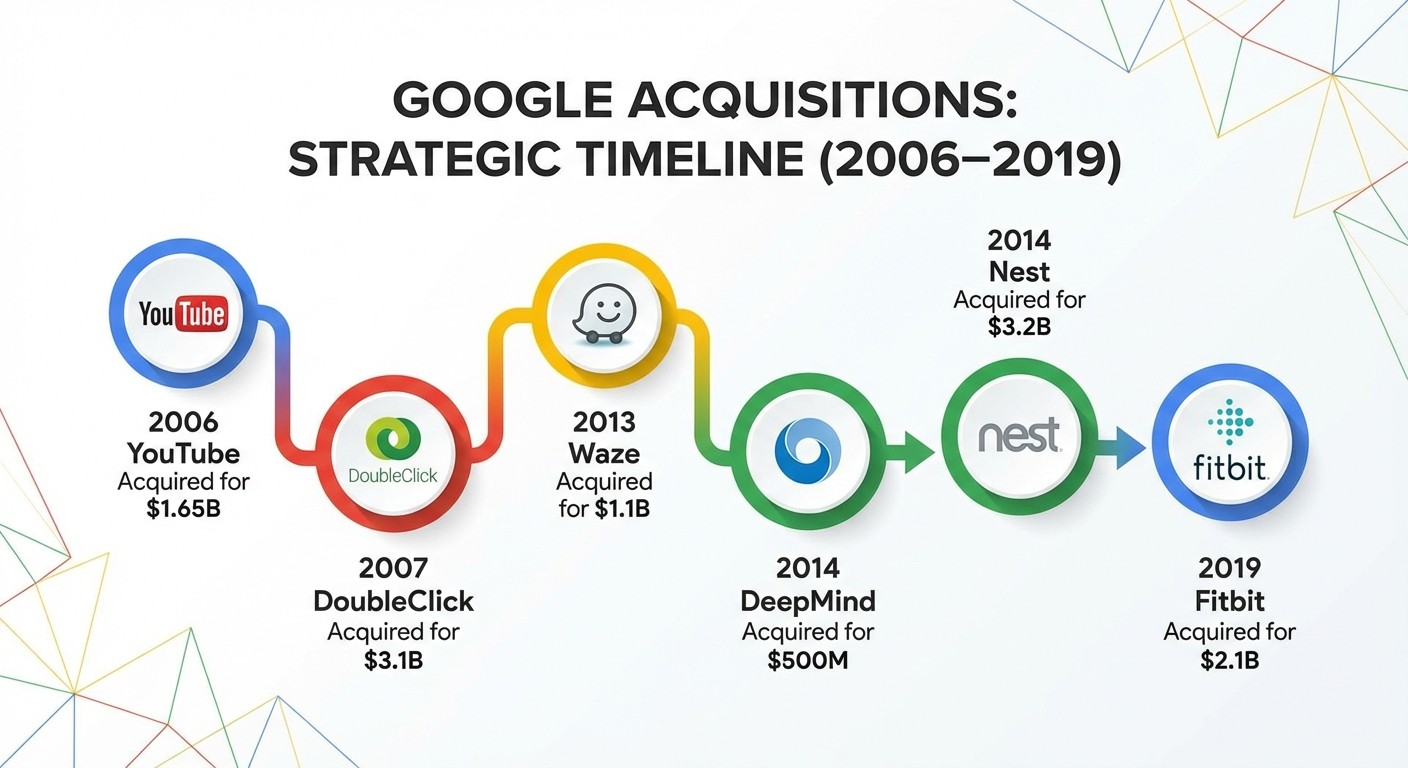
Key Statistics
- Total Acquisitions: 260+ companies (2001-2025)
- Peak Year: 2014 (35 acquisitions)
- Largest Deal: Motorola Mobility - $12.5 billion (2012)
- Most Valuable Active Acquisition: YouTube - $1.65B (2006)
- Products Shut Down: ~60% of acquired products (the "Google Graveyard")
Google's Biggest Acquisitions
| Company | Year | Price | Outcome |
|---|---|---|---|
| Motorola Mobility | 2012 | $12.5B | Sold to Lenovo (2014) for $2.9B; patents retained |
| Nest Labs | 2014 | $3.2B | Operating as Google Nest |
| DoubleClick | 2008 | $3.1B | Core of Google Ads business |
| Looker | 2020 | $2.6B | Part of Google Cloud |
| Fitbit | 2021 | $2.1B | Operating under Google |
| YouTube | 2006 | $1.65B | Most successful acquisition - now worth $100B+ |
| Waze | 2013 | $1.15B | Operating independently alongside Google Maps |
| Mandiant | 2022 | $5.4B | Part of Google Cloud security |
| HTC Pixel Division | 2017 | $1.1B | Integrated into Pixel hardware team |
| ITA Software | 2011 | $700M | Powers Google Flights |
Game-Changing Acquisitions
Android (2005) - $50 Million
Perhaps the most consequential acquisition in Google's history, Android was purchased in 2005 for approximately $50 million. At the time, Google was primarily a search company, and mobile was dominated by Nokia and BlackBerry. Android now powers over 70% of the world's smartphones - easily one of the most successful acquisitions ever made.
YouTube (2006) - $1.65 Billion
Critics called it overpriced at the time. YouTube was just 18 months old with no clear path to profitability and significant copyright liability. Nearly two decades later, YouTube generates over $30 billion in annual advertising revenue and is estimated to be worth over $100 billion. The most successful video acquisition in history.
DoubleClick (2008) - $3.1 Billion
This acquisition faced intense regulatory scrutiny but ultimately defined Google's advertising business. DoubleClick's ad serving technology became the backbone of Google's display advertising empire.
Waze (2013) - $1.15 Billion
Waze continues to operate independently - a rarity for Google acquisitions. The crowdsourced navigation app maintains its own identity while sharing data with Google Maps. This "let it run" approach is the exception rather than the rule at Google.
The Google Graveyard: Acquisitions That Were Shut Down
Google has a notorious reputation for killing products - including many acquisitions. Notable shutdowns include:
| Product | Acquired | Shut Down | What Happened |
|---|---|---|---|
| Google Reader (Feedburner) | 2007 | 2013 | Sparked "Google Graveyard" meme |
| Sparrow | 2012 | 2012 | Acqui-hire, team joined Gmail |
| Meebo | 2012 (~$100M) | 2012 | Acqui-hire for Google+ |
| Bump | 2013 | 2014 | Team joined Google+ |
| Revolv | 2014 | 2016 | Hardware bricked - controversial |
| Songza | 2014 | 2016 | Integrated into Google Play Music |
| Aardvark | 2010 ($50M) | 2011 | Q&A service failed |
| Slide | 2010 ($182M) | 2011 | Social apps never launched |
| Picnik | 2010 | 2012 | Folded into Google+ |
| Quickoffice | 2012 | 2014 | Integrated into Google Docs |
Acquisitions by Category
Advertising Technology (~25 acquisitions)
DoubleClick, AdMob ($750M), Invite Media, Admeld, and dozens more form the backbone of Google's $200B+ advertising business.
Cloud & Enterprise (~30 acquisitions)
Looker ($2.6B), Mandiant ($5.4B), Apigee ($625M), and others power Google Cloud Platform.
AI & Machine Learning (~40 acquisitions)
DeepMind ($500M+), Kaggle, api.ai, and many AI startups fuel Google's AI leadership.
Hardware (~15 acquisitions)
Nest ($3.2B), Fitbit ($2.1B), HTC Pixel team ($1.1B), and Motorola ($12.5B, later sold).
Mobile (~20 acquisitions)
Android ($50M), Waze ($1.15B), and numerous mobile technology companies.
Google Acquisition Statistics
| Metric | Value |
|---|---|
| Total Acquisitions (2001-2025) | 260+ |
| Total Disclosed Spending | ~$40B+ |
| Most Active Year | 2014 (35 deals) |
| Largest Acquisition | Motorola ($12.5B) |
| Most Successful ROI | YouTube, Android |
| Products Shut Down | ~60% |
| Products Still Operating | ~25% |
| Integrated/Absorbed | ~15% |
Failed and Controversial Acquisitions
Motorola Mobility ($12.5B → Sold for $2.9B)
Google bought Motorola in 2012 primarily for its patent portfolio. After two years of losses, Google sold the hardware business to Lenovo for $2.9B, keeping the patents. A $10B loss on paper, though the patents may have been worth it.
Wiz ($23B Rejected, 2024)
Google's largest-ever attempted acquisition was rejected by Wiz, which chose to pursue an IPO instead. This would have been Google's biggest deal ever.
Slide ($182M → Shut Down in 1 Year)
Acquired in 2010 to boost Google's social efforts. All Slide products were shut down within a year. The team, led by PayPal co-founder Max Levchin, didn't last long at Google.
Frequently Asked Questions About Google Acquisitions
How many companies has Google acquired?
Google (Alphabet) has acquired over 260 companies since 2001. The actual number is likely higher, as many small acqui-hires are never publicly announced. Google's most active acquisition year was 2014, with 35 deals completed.
What was Google's biggest acquisition?
Google's largest acquisition was Motorola Mobility in 2012 for $12.5 billion. However, this was largely for patents - Google sold the hardware business to Lenovo in 2014 for $2.9B. Other major deals include Mandiant ($5.4B), Nest ($3.2B), DoubleClick ($3.1B), and Fitbit ($2.1B).
What was Google's most successful acquisition?
By return on investment, Android ($50M in 2005) and YouTube ($1.65B in 2006) are the most successful. Android powers 70%+ of smartphones globally. YouTube generates $30B+ in annual revenue and is estimated to be worth over $100B. Both acquisitions transformed Google from a search company to a platform giant.
Why does Google shut down so many acquired products?
Google has a reputation for killing products (the "Google Graveyard"). Many acquisitions are acqui-hires where talent was the goal, not the product. Google also has strict usage thresholds - products that don't gain traction get sunset. Additionally, many acquisitions are folded into existing Google products rather than operated separately.
What is the Google Graveyard?
The "Google Graveyard" (killedbygoogle.com) catalogs discontinued Google products. It includes acquired companies like Sparrow, Meebo, and Bump, as well as internally-developed products like Google+, Stadia, and Google Reader. The site has over 250 entries and has become symbolic of Google's willingness to kill products.
When did Google buy YouTube?
Google acquired YouTube in October 2006 for $1.65 billion in stock. At the time, YouTube was just 18 months old and had no clear monetization strategy. Critics called it overpriced. Today, YouTube generates over $30 billion annually and is considered one of the most successful acquisitions in tech history.
When did Google buy Android?
Google acquired Android Inc. in July 2005 for approximately $50 million. Android was a small startup working on mobile operating systems, led by Andy Rubin. The first Android phone launched in 2008. Today, Android runs on over 3 billion devices worldwide - perhaps the best acquisition ROI in tech history.
Does Google still make acquisitions?
Yes, Google continues to make acquisitions, though the pace has slowed due to increased regulatory scrutiny. Recent notable deals include Mandiant ($5.4B, 2022) for cybersecurity. Google's attempted $23B acquisition of Wiz in 2024 was rejected by the target company. Regulatory approval has become more challenging for large tech acquisitions.
How much has Google spent on acquisitions?
Google has spent over $40 billion on disclosed acquisitions since 2001. The actual total is higher due to undisclosed acqui-hires. Largest deals: Motorola ($12.5B), Mandiant ($5.4B), Nest ($3.2B), DoubleClick ($3.1B), Fitbit ($2.1B), YouTube ($1.65B). Many smaller deals are in the $10-100M range.
What happened to Nest after Google bought it?
Google acquired Nest Labs in 2014 for $3.2 billion. Nest initially operated semi-independently under Alphabet but was merged into Google's hardware division in 2018. Products are now sold under the "Google Nest" brand. Founders Tony Fadell and Matt Rogers have since left the company.
Did Google buy DeepMind?
Yes, Google acquired DeepMind in 2014 for approximately $500 million (exact terms undisclosed). DeepMind is an AI research lab that created AlphaGo, AlphaFold, and other breakthrough AI systems. It continues to operate as a distinct research organization within Alphabet, focused on general AI research.
What happened to Waze after Google acquired it?
Google acquired Waze in 2013 for $1.15 billion. Unlike most Google acquisitions, Waze has continued operating as an independent app alongside Google Maps. Data flows between the two products, but Waze maintains its distinct brand, community features, and user interface. This "let it run" approach is unusual for Google.