Meta (formerly Facebook) has executed some of the most consequential acquisitions in tech history. The $1 billion Instagram deal and $19 billion WhatsApp acquisition transformed Facebook from a social network into a global communications empire. This database tracks all 92 Meta acquisitions from the company's first deal in 2005 to present.
Mark Zuckerberg's acquisition strategy has been aggressive and prescient - buying potential competitors before they became threats and acquiring technologies that would define the next computing platform (VR/AR with Oculus).
Key Statistics
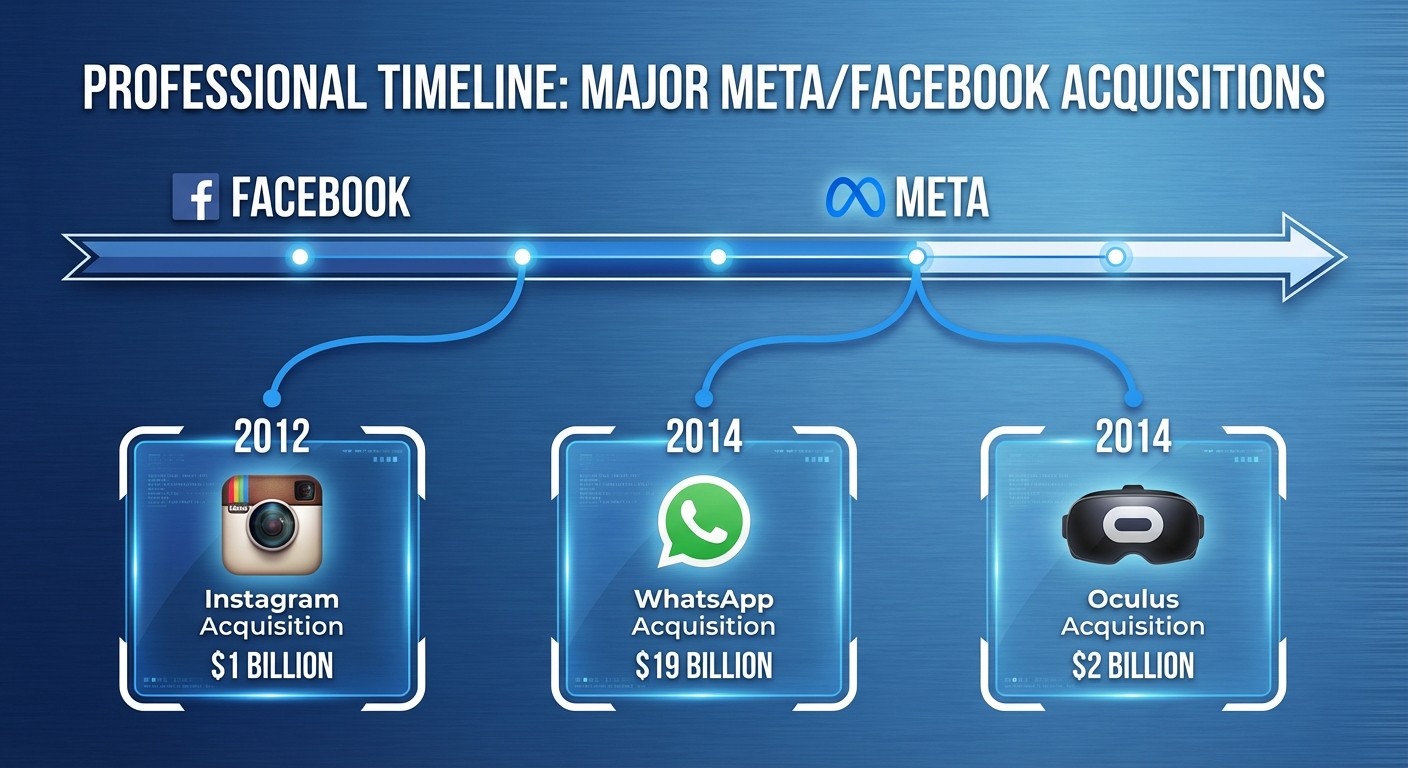
- Total Acquisitions: 92 companies (2005-2025)
- Peak Year: 2014 (12 acquisitions including WhatsApp & Oculus)
- Largest Deal: WhatsApp - $19 billion (2014)
- Most Valuable Today: Instagram - worth $100B+ (bought for $1B)
- VR/AR Acquisitions: 15+ companies for metaverse
Meta's Biggest Acquisitions
| Company | Year | Price | Outcome |
|---|---|---|---|
| 2014 | $19B | 2B+ users, operating independently | |
| 2012 | $1B | 2B+ users, now worth $100B+ | |
| Oculus VR | 2014 | $2B | Foundation of Meta's VR/metaverse bet |
| Kustomer | 2020 | $1B | Customer service platform for businesses |
| Mapillary | 2020 | Undisclosed | Street-level imagery for maps |
| CTRL-labs | 2019 | $500M-1B | Neural interface for VR/AR |
| Beat Games (Beat Saber) | 2019 | Undisclosed | VR gaming studio, killer app for Quest |
| Giphy | 2020 | $400M | Forced to sell by UK regulators (2023) |
| Within (Supernatural) | 2022 | $400M | VR fitness app, FTC challenged |
| LiveRail | 2014 | $400-500M | Video ad tech, shut down 2016 |
The Instagram Acquisition: Best Tech Deal Ever?
In April 2012, Facebook announced it was acquiring Instagram for $1 billion - a 13-person company with zero revenue and 30 million users. Critics called it insane. Mark Zuckerberg was questioned by his own board.
Today, Instagram has over 2 billion monthly active users and generates an estimated $50+ billion in annual advertising revenue. The company is worth at least $100 billion, making this arguably the best acquisition in tech history - a 100x return in just over a decade.
Why It Worked
- Mobile-first: Instagram caught the smartphone photography wave
- Autonomous operation: Kevin Systrom ran Instagram independently for years
- Network effects: Facebook's scale accelerated Instagram's growth
- Competitive moat: Prevented Google or Twitter from acquiring it
The WhatsApp Mega-Deal
In February 2014, Facebook shocked the world by paying $19 billion for WhatsApp - then the largest acquisition of a venture-backed company ever. WhatsApp had 450 million users but minimal revenue from its $1/year subscription model.
The deal included $4 billion in cash, $12 billion in Facebook stock, and $3 billion in restricted stock units. Founder Jan Koum joined Facebook's board but later departed over privacy disagreements.
WhatsApp Today
- 2+ billion users worldwide
- Dominant in emerging markets: India, Brazil, Indonesia
- WhatsApp Business: Monetization through business tools
- End-to-end encryption: Maintained despite pressure
The Metaverse Bet: VR/AR Acquisitions
Meta has acquired at least 15 VR/AR companies as part of its metaverse strategy:
| Company | Year | Focus |
|---|---|---|
| Oculus VR | 2014 | VR headsets |
| Surreal Vision | 2015 | 3D scene reconstruction |
| Two Big Ears | 2016 | Spatial audio |
| CTRL-labs | 2019 | Neural interfaces |
| Beat Games | 2019 | VR gaming (Beat Saber) |
| Sanzaru Games | 2020 | VR game development |
| Ready At Dawn | 2020 | VR game studio |
| BigBox VR | 2021 | VR multiplayer games |
| Within (Supernatural) | 2022 | VR fitness |
| Armature Studio | 2022 | VR game development |
Acquisitions That Failed or Were Blocked
Giphy - Forced Divestiture
Meta acquired Giphy in 2020 for $400 million, but UK regulators (CMA) ruled the deal anti-competitive in 2021. After a lengthy legal battle, Meta was forced to sell Giphy in 2023 - a rare case of a completed acquisition being unwound.
Within (Supernatural) - FTC Challenge
The FTC sued to block Meta's acquisition of VR fitness app Within in 2022, arguing it would harm competition in the nascent VR fitness market. Meta won in court, but the case signaled increased scrutiny of Meta's acquisitions.
Products That Were Shut Down
- tbh (2017) - Teen compliment app, shut down 2018
- Moves (2014) - Fitness tracking, shut down 2018
- Parse (2013) - Mobile backend, shut down 2017
- LiveRail (2014) - Video ads, shut down 2016
- FriendFeed (2009) - Social aggregator, shut down 2015
Meta Acquisition Statistics
| Metric | Value |
|---|---|
| Total Acquisitions (2005-2025) | 92 |
| Total Disclosed Spending | ~$25B+ |
| Most Active Year | 2014 (12 deals) |
| Largest Acquisition | WhatsApp ($19B) |
| Best ROI | Instagram (100x+) |
| VR/AR Acquisitions | 15+ |
| Products Shut Down | ~20 |
Frequently Asked Questions
How many companies has Meta/Facebook acquired?
Meta (formerly Facebook) has acquired 92 companies since 2005. Major acquisitions include Instagram ($1B, 2012), WhatsApp ($19B, 2014), and Oculus VR ($2B, 2014). The company has been particularly active in acquiring VR/AR companies for its metaverse ambitions.
How much did Facebook pay for Instagram?
Facebook acquired Instagram in April 2012 for $1 billion in cash and stock. At the time, Instagram had just 13 employees and 30 million users. Today, Instagram has over 2 billion users and is estimated to be worth over $100 billion - making it one of the best acquisitions in tech history.
How much did Facebook pay for WhatsApp?
Facebook acquired WhatsApp in February 2014 for $19 billion ($4B cash, $12B stock, $3B RSUs). This was the largest acquisition of a venture-backed company at the time. WhatsApp now has over 2 billion users and is dominant in markets like India, Brazil, and Europe.
What happened to Oculus after Facebook bought it?
Facebook acquired Oculus VR in 2014 for $2 billion. The company became the foundation of Meta's VR strategy, producing the Quest line of headsets. Oculus founder Palmer Luckey left in 2017. In 2022, the Oculus brand was retired and products are now branded as "Meta Quest."
Why was Meta forced to sell Giphy?
UK regulators (CMA) ruled Meta's 2020 acquisition of Giphy was anti-competitive. They argued Meta could deny competitors access to Giphy's GIF library and that the deal reduced potential competition in display advertising. After losing appeals, Meta sold Giphy in 2023.
What is Meta's acquisition strategy?
Meta's strategy includes: (1) Acquiring potential competitors early (Instagram, WhatsApp); (2) Buying technology for new platforms (Oculus for VR); (3) Acqui-hires for talent; (4) Strategic acquisitions to enhance core products. The company has faced increasing regulatory scrutiny, making large acquisitions harder.
Which Meta acquisitions were shut down?
Notable shutdowns include: tbh (teen app, 2018), Moves (fitness, 2018), Parse (mobile backend, 2017), LiveRail (video ads, 2016), and FriendFeed (social aggregator, 2015). Many smaller acqui-hires also had their products discontinued as teams were absorbed into Facebook.
How much has Meta spent on VR/AR acquisitions?
Meta has spent an estimated $4-5 billion on VR/AR acquisitions, including Oculus ($2B), CTRL-labs ($500M-1B), Within ($400M), and numerous game studios. This doesn't include the tens of billions Meta has invested in internal VR/AR development through Reality Labs.
What was Facebook's first acquisition?
Facebook's first acquisition was Aboutface in 2005, a small company that provided facial recognition technology for organizing photos. The technology was integrated into Facebook's photo tagging features. The deal terms were not disclosed.
Can Meta still make large acquisitions?
Meta faces significant regulatory barriers to large acquisitions. The FTC has signaled it may challenge deals, and international regulators (UK CMA, EU) have become more aggressive. The Giphy forced sale and Within lawsuit show the increased scrutiny. Meta can still make smaller acquisitions but "Instagram-sized" deals are much harder now.
Is Instagram still independent from Facebook?
Instagram operated somewhat independently until 2018, when founders Kevin Systrom and Mike Krieger departed over disagreements with Mark Zuckerberg about Instagram's direction. Today, Instagram is fully integrated into Meta, sharing infrastructure, advertising systems, and increasingly, features with Facebook.
What happened to WhatsApp's founders after the acquisition?
WhatsApp co-founder Jan Koum joined Facebook's board but left in 2018, reportedly over disagreements about data privacy and advertising. Co-founder Brian Acton left in 2017 and later funded Signal, a privacy-focused WhatsApp competitor. Both became billionaires from the acquisition.